Of course, it doesn't go after the jugular of faith as much as I'd like (it seems the only opposition to the LHC comes from a handful of religious scientists and a fair number of religiously-motivated layman) as a research paper shouldn't, but it'll do.

Science...it's how we know, bitches!
Abstract
________________________________________
________________________________________
The LHC is 7,000 more times powerful than any other particle accelerator ever created (LHC Safety Study Group). This has led to a renewed concern over the safety of high-energy particle collisions. This paper will examine the main safety arguments from both sides. The original safety concerns of high-energy particle collisions are the production of stranglets (stranglets will be described later in this paper) and micro black holes. Stranglet concerns have been disregarded because other particle colliders like the RHIC actually have a higher chance of creating stranglets (LHC Safety Study Group). In addition, most of the scientific community has dismissed micro black hole arguments with arguments centered on cosmic rays and Hawking radiation (Benjamin Koch). Many members of the scientific community, including the German Society of Physicists (KET), claim that lone arguments like Dr. Rossler’s arguments are based on a fundamentally flawed understanding of Einstein’s general theory of relativity. It is the conclusion of this paper that LHC poses absolutely no danger to the Earth or humanity, and furthermore, the research from the LHC could fundamentally change the way we understand the universe and could lead to science fiction-like technologies.
Introduction
__________________________
Description of the LHC
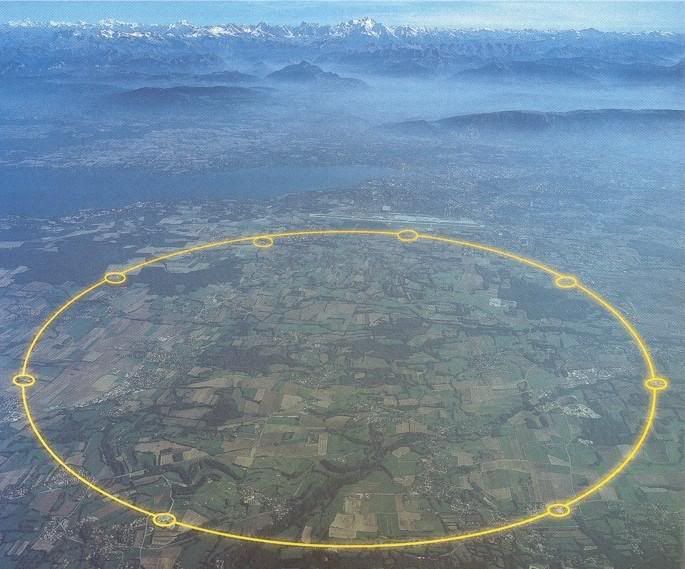 The LHC is the largest, most expensive, most technologically advanced, and most powerful science experiment ever built by man. The LHC is a particle collider that physicists use to study the fundamental nature of matter by learning how particles behave during collisions. The LHC is designed to collide opposing beams of protons or lead ions and take extremely high-resolution pictures of those collisions. What makes the LHC so unique is that it is capable of accelerating particles to near the speed of light. It uses a huge series of the largest superconducting magnets ever built to shove particles though a metal 3.8-meter wide 17-mile circumference circle. It is located mostly in France and crosses the Franco-Swiss border at four different points. CERN (European Organization for Nuclear Research) began construction of the 8.2 billion dollar project in 1986. Construction was completed in summer 2008 and test runs commenced in September. However, during a test run one of the magnets failed and caused operations to cease until summer of 2009 (Large Hadron Collider).
Purpose of the LHC
In the standard model of particle physics, the last unobserved particle is called the Higgs boson. If the standard model is correct, the Higgs boson should exist. The Higgs boson is smaller than atoms, the protons and neutrons that make atoms, and the quarks that make protons and neutrons. It is theorized that Higgs boson is what gives all particles mass. However, since the Higgs boson has never been observed, the standard model is incomplete. It is hoped that during high energy collisions the Higgs boson will be created by breaking up other particles thus confirming the standard model. There are other less powerful colliders that have failed to create the Higgs boson, like the Relativistic Heavy Ion Collider (RHIC) in New York. It is the hope of physicists that accelerating the particles to 99.999% speed of light the LHC will finally produce the Higgs boson (Large Hadron Collider). However, the most exciting part about the LHC is the possibility of proving the standard model wrong or finding other particles predicted by highly theoretical extensions of the standard model. For instance, the first real physical evidence of extra dimensions predicted by string theory might be observed at the LHC, or the graviton might finally be directly observed. If we can observe, predict, and control gravitons, things such as anti-gravity, artificial gravity and floating cars will be more of a reality instead of science fiction. However, it is expected that LHC will fall short of creating the energies for these theoretical particles to form, and that the LHC will not even find the Higgs boson. In fact, Steven Hawking, a world famous physicist, has placed a 100 dollar bet that LHC will not find the Higgs boson. He added, “That [the LHC] will show something is wrong, and we will need to think again” (BBC).
LHC opposition
The LHC has been subject to opposition from within the scientific community. The opposition is primarily related to safety concerns, like stranglets and micro black holes; however, there are some moral and ethical concerns as well. The scientific opposition is isolated to a few individuals, and has largely been considered discounted by the rest of the scientific community (KET) (Plaga) (Benjamin Koch) (Rossler). The scientific opposition consists of a few individuals working alone to form what other scientists consider self-contradicting arguments. By contrast, the response to scientific concern is dismissed by CERN-sponsored studies and large groups of independent scientists working together. The ethical concern is why the LHC has received billions of dollars for its construction while there are other issues, like poverty, deserving of the funding (Rossler). Poverty and other issues are very deserving of the LHC’s funding, but the LHC’s potential impact on science and humanity certainly justifies the LHC’s large price tag.
The first objections to the LHC’s safety were brought before it was even close to being completed. Similar arguments were brought up at the RHIC in New York. Walter L. Wagner is an American botanist and a former radiation safety officer. He earned his Biology degree with a minor Physics from UC Berkeley. Wagner contended that the differences between high-energy collisions with cosmic rays and the upper atmosphere are different from the “at rest” collisions at the LHC and could potentially have catastrophic consequences in the form of an Earth-devouring black hole. He tried to stop full-energy collisions unsuccessfully in US and European courts (Lite). Dr. Otto E. Rossler has similar concerns about black hole creation, but his arguments are considered self-contradicting and fail to bridge gaps between his claims and evidence (KET). The most recent and convincing arguments come from a German astrophysicist, Dr. Plaga Rainer. Dr. Rainer believes that you cannot rule out the possibility, however unlikely, of Earth-devouring black holes and dangerous theoretical Hawking radiation (Plaga). Ultimately, all of the opposition has failed to stop the LHC from operating at its full capacity. In summer of 2009 the LHC will achieve energies five times that of any collider before it (Large Hadron Collider).
Stranglets
__________________________
Stranglet properties
Stranglets are microscopic parcels of strange matter. In particle physics, normal atoms made up of protons, neutrons, and electrons are called nuclear matter. Nuclear matter is what the elements consist of and what gives them their unique properties. The individual protons, neutrons, and electrons are made up of quarks--specifically, up and down quarks. However, strange matter equally consists of up, down, and strange quarks while nuclear matter does not contain strange quarks. Strange matter more simply put is matter made of equal numbers of up, down, and strange quarks that are more stable than nuclear matter, but for the purposes of this paper, negative stranglets are the subject for concern. Positive stranglets would be repelled by ordinary matter posing no threat. However, negative stranglets would actually be attracted to normal matter. It is theorized if negative stranglets were to come into contact with ordinary matter, it would instantaneously convert the nuclear matter into strange matter removing any properties it originally had. The concern is that a negative stranglet could convert the entire Earth into strange matter erasing at the atomic level every unique property about the Earth (Witten).
Evidence against stranglets
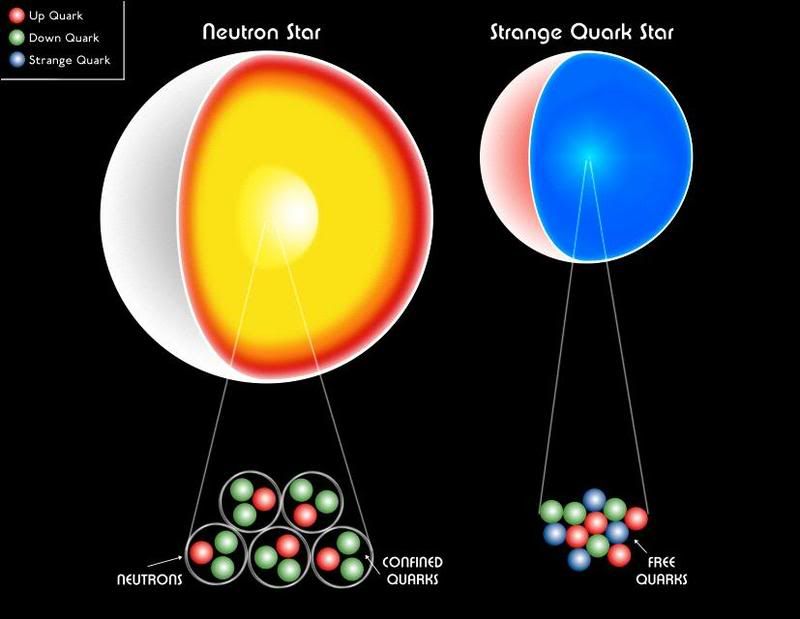 First, strange matter has never been observed anywhere. Strange quarks have been detected and created in laboratories for decades, but they have always decayed within a nanosecond, and more importantly have never created a stranglet. Strange matter is supposed to be the end product of nuclear matter if nuclear matter is not stable infinitely. It is also purely theory that strange matter could be more stable than nuclear matter. Regardless, the most likely place to find strange matter is neutron stars. Neutron stars are the end product of a star that is not quite massive enough to turn into a stellar black hole, but much more massive than our own star. At the atomic level, neutron stars are literally a gigantic nucleus packed so tight that individual atoms cannot form. Neutron stars are the focus of the search for strange matter and the focus of stranglet arguments (LHC Safety Study Group) (John Ellis).
If a neutron star contains strange matter it is called a strange star. However, there are many difficulties when it comes to finding these theoretical strange stars. Astronomers have been observing neutron stars for many decades, but the problem with detecting strange stars is that we are not sure what the observable difference is between strange stars and neutron stars. There are many great starting points, but astronomers lack the understanding of strange matter to form observational tests. However, observations of neutron stars have not demonstrated great cause to doubt they are neutron stars. In essence, we have not found any strange stars which when taken in context with the LHC, gives reason to worry about the formation of negative stranglets (Ghosh) (LHC Safety Study Group) (John Ellis).
Micro black holes
__________________________
Black hole properties
Micro black holes are essentially black holes that have incredibly low mass. In astrophysics, we believe that the smallest star that can form into a black hole is estimated to be 25 solar masses or 25 times the mass of our sun. Normal black holes usually come in two types: stellar mass black holes formed from the collapse of
 super-massive stars and billion plus solar mass super-massive black holes at the center of most galaxies (Black Hole). The common understanding of black holes sucking up everything around it is incorrect. Except for the event horizon, everything is normal about the gravitational field. For instance, if our sun was to magically turn into a black hole right now, our orbit, Mercury’s orbit, Jupiter’s orbit, or any other gravity-dependent variable would not change in any way whatsoever. However, our solar system would freeze because black holes do not shine as our star does. Besides the fact that our sun will never be a black hole, the only difference between it and its theoretical black hole twin is its radius. In our sun’s case, the radius is much larger than its event horizon. The sun’s black hole twin has a radius that is smaller than it’s event horizon. The event horizon is the point where light can no longer reach escape velocity. On the other hand, micro black holes have been theorized to form when super high-energy cosmic rays collide with atmospheres or the surfaces of neutron stars. At this incredibly low mass, micro black holes are supposed to evaporate into bright flashes of dangerous gamma radiation, according to Steven Hawking. Almost the entire scientific community has regarded the radiation to be negligible because it would be such a small amount. The other concern about micro black holes are if this incredibly small black hole could begin to accrete. They have masses around the atomic level, so their gravity is very small. Not only would it be very implausible for micro black holes to accrete a significant amount of matter, they are expected to leave the Earth near the speed of light.
Scenarios of micro black hole formation
There are two main scenarios proposed for micro black hole formation. However, Dr. Plaga proposes a third scenario that he believes is the one to be concerned about.
• The produced micro black holes decay immediately in flashes of gamma radiation via Hawking radiation.
• The produced micro black hole would pass through the Earth in any direction near the speed of light accreting an infinitesimally small amount of matter, if any.
• Dr. Plaga believes that astrophysical evidence does not rule out the idea of a micro black hole accreting matter, and that a micro black hole could be stable and not escape Earth’s gravity because the particles at the LHC collide from opposing directions at similar energies while cosmic rays collide with much greater energies from a single direction.
Evidence against dangerous micro black holes
The main concern about micro black holes and the LHC is that when the LHC is colliding protons at its maximum energy of 7 TeV micro black holes could form. One of the main arguments against the black hole formation within the LHC is cosmic rays. Cosmic rays are high energy rays that originate from things like supernovae and black holes. These cosmic rays have energies that are literally 100,000 times greater than what the LHC produces. Throughout Earth’s 4.5 billion year history over 100,000 cosmic rays have struck the Earth. The basic argument is that if these much more powerful collisions that occur with cosmic rays happen all the time while the Earth still exists, then the much less powerful collisions at the LHC pose no threat (John Ellis) (Steeven B. Giddings).
Some people have rightly pointed out that the model of cosmic ray collisions with the Earth does not rule out dangerous micro black holes (Plaga). A much more convincing argument lies in astrophysics. As said earlier, neutron stars are essentially huge atoms because the neutrons are packed so tightly atoms do not have room to form. These neutron stars are the perfect target for cosmic rays. The fact that neutron stars are so dense exponentially raises the probability that a micro black hole would form from cosmic ray collisions. In observations of neutron stars, no micro black holes have ever been observed accreting mass from neutron stars (John Ellis).
Shortly after Dr. Plaga published his article making the claim that micro black holes could remain in the Earth and accrete matter at a runaway rate, Dr Steven B. Giddings and Michelangelo L. Mangano published a paper claiming that Dr. Plaga’s math contains basic inconsistencies. Also, another paper titled Exclusion of black hole disasters at the LHC was published summarizing all arguments made for black hole formation, and the paper concluded that the LHC poses no danger in any logical manner. The basic argument behind dismissing Dr. Plaga’s argument is if micro black holes can remain within the Earth’s gravitational influence, then it must occur in things like neutron stars where the gravity is much stronger. Also, if the black hole does remain within the Earth or neutron stars, there is no risk of the black hole accreting matter on timescales less than its natural lifetime (The Earth’s natural lifetime is estimated to be 13 billion years.). Essentially, because a neutron star has never turned into a black hole and that Dr. Plaga’s math is inconsistent, the last remaining scenario of a black hole disaster poses no danger at all (Benjamin Koch) (John Ellis) (Steeven B. Giddings).
Conclusion
__________________________
The LHC represents the next great step in our understanding of how matter works. The standard model that physicists have been working on for decades could be proven correct, or it could send physicists back to the drawing board as Stephen Hawking predicts. If the LHC discovers extra dimensional particles, like the graviton, the LHC could shed light on string theory or even the multi-verse theory. Up until now, those theories have only consisted of elegant mathematical formulas with no physical evidence making them largely hypothetical. For the first time ever the LHC could turn them into real physical science. If the graviton can finally be observed, man’s future space exploration could greatly exceed the bounds of our solar system. Things like floating cars or anti-gravity enhanced spacecraft that could finally make space travel economical could exist. Graviton control could make things like moon bases and Mars bases a fraction of a percent of their current proposed costs.
Not only is it extremely exciting for particle physicists, it is also exciting for big bang researchers. The LHC will spend some of its operating time recreating energies that have not been seen in the universe since almost instantly after the big bang occurring. While the big bang theory explains the current observable evidence, it does not explain everything about how the big bang actually worked. The LHC could solidify or modify the big bang theory to a much higher degree increasing our understanding of the origin of our universe greatly.
After examining the current scientific debate about dangerous scenarios at the LHC, it becomes clear than neither stranglets or micro black holes pose any real danger. The proposed dangerous scenarios for stranglets already exist at places like the RHIC, and the LHC is actually less likely to produce stranglets than the RHIC. Also, all proposed scenarios for micro black hole formation have been examined in great detail by many in the scientific community, and there is a consensus among almost all scientists that none of the possible scenarios for micro black hole formation pose any threat to the Earth. This concludes that the LHC poses absolutely no danger, and it represents the next great leap in our understanding of the universe.
Works Cited
__________________________
BBC. On the hunt for the Higgs boson. 9 September 2008. 19 November 2008 <http://news.bbc.co.uk/toda
Benjamin Koch, Marcus Bliecher, Horst Stocker. "Exclusion of black hole disaster scenarios at the LHC." arXiv (2008).
Black Hole. 19 November 2008. 19 November 2008 <http://en.wikipedia.org/wi
Ghosh, Sanjay K. "Astrophysics of Strange Matter." arXiv (2008).
John Ellis, Gian Giudice, Michelangelo Mangano, Igor Tkachev, Urs Wiedemann. Review of the Safety of LHC Collisions. CH 1211 Geneva 23, Switzerland: Theory Division, Physics Department, CERN, 2008.
KET. "The LHC is safe." Wuppertal: University of Wuppertal, 1 August 2008.
Large Hadron Collider. 19 November 2008. 19 November 2008 <http://en.wikipedia.org/wi
LHC Safety Study Group. Study of potentially dangerous events during heavy-ion collisions at the LHC: Report of the LHC Safety Study Group. Geneva: CERN, 2003.
Lite, Jordan. Judge scraps lawsuit over Large Hadron Collider. 9 September 2008. 19 November 2008 <http://www.sciam.com/blog/
Plaga, Rainer. "On the potential catastrophic risk from metastable quantium-black holes produced at particle colliders." arXiv (2008).
Rossler, Otto E. A Rational and Moral and Spiritual Dilemma. Tubingen: University of Tubingen, 2008.
Steeven B. Giddings, Michelangelo L. Mangano. "Astrophysics implications of hypothetical stable TeV-scale black holes." Physical Review (2008).
Witten, Edward. "Cosmic Separation of Phases." Physical Review (1984).

