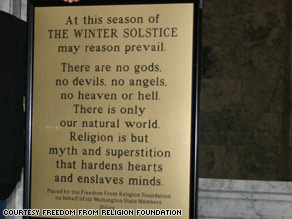
So...
It is the atheists who are trying to trample on others rights?
We are the intolerant ones?
Aaarrgghhsz.
Canada apologizes for mistreatment Government says it regrets role in abuse of aboriginals at church-run schools |
| By RON CSILLAG, Religion News Service First published: Saturday, June 14, 2008 |
| TORONTO -- For the second time in a decade, the Canadian government has apologized to the country's aboriginal peoples for its role in abuse at church-run residential schools. |
"The government now recognizes that the consequences of the Indian residential schools policy were profoundly negative and that this policy has had a lasting and damaging impact on aboriginal culture, heritage and language," Harper said Wednesday in Parliament, with an audience that included 12 native leaders.
In the 1870s, the schools began forcibly removing aboriginal children from their homes in an attempt to assimilate them into the dominant white, Christian culture.
To my surprise, she responded:
Hello,
I read your article about Expelled today, and it was clear that your own lack of objectivity in viewing Expelled carried into your writing. Since it appeared in a Christian news publication, where truth (especially scientific truth) takes a back seat to confirming things you already think you know, I doubt you'll care to receive the antidote to your ignorance of science that I'm going to take the time to provide for you - but I'm an optimist. :D
First, you have freedom of speech - you can suggest whatever you like. However, while the United States is a Democracy, science is not. The idea of Intelligent Design is being rejected because it fails the litmus test of what is scientific. I will detail why it does not later in this e-mail.
While Darwin was the first to note that species evolve 150 years ago (as you point out), the theory has since been modified to accommodate what we have learned since then. The fact that we came to know the original theory 150 years ago does not devalidate it any more than the age of the Christian story devalidates it (there are plenty of other things that manage that). If creationists are intent on coming up with "new and better idea's" (your unnecessary apostrophe left in place), they must still endure even the most minimal application of the scientific method which Evolution has withstood for 150 years.
The blog you cite also gets many things wrong. First, it says the film is honest. The filming of the movie was not even done in an honest fashion. All of the opposing voices in the movie, from Michael Shermer to Dawkins to Myers to Eugenie Scott, were filmed for the movie under false pretenses. Yes, the producers flat out lied to them. They were told that Crossroads (the movie the interviewees were told they were being interviewed for) would explore the clash between ID and science, not the propaganda piece that Expelled would be. The interviewees were later told that Crossroads was the working title for the movie, but the domain name for Expelled was purchased months before the interviews took place. This was a bait and switch by the producers of the movie in order to get somebody to demonize.
As for the scholars in the movie being fired or otherwise defaced for supporting Creationism, you can find a full dissection of these claims on my review of the movie at http://jteberhard.blogspot.com/2008/04/review-of-expelled-or-win-ben-steins.html. Enjoy.
Anyway, on to why ID is not science. This can be found on my ongoing blog on Evolution at http://tehjuggernauts.blogspot.com/2008/04/what-evolution-is-not-is-evolution.html under "What is Science". I also touch on it more in my essay at http://tehjuggernauts.blogspot.com/2008/05/why-we-must-oppose-intelligent-design.html. Here is the relevant excerpt:
"In order to determine whether an idea is a scientific theory, we must first know what makes an idea scientific and how scientists utilize the term "theory". While I may have a theory regarding what two cards my opponent is holding at the poker table, this is not the way scientists use the word. A scientific theory "summarizes a hypothesis or group of hypotheses that have been supported with repeated testing" and is "valid as long as there is no evidence to dispute it" (Helmenstine). This is a far cry from the anthems that Evolution is "just a theory" we hear from a nation of non-biologists wishing to have a deciding hand in an issue they admit their ignorance of by invoking that phrase.
"For a theory to be "scientific," it must provide the basis for testable hypotheses" (Olmstead). When scientists like Eugenie Scott say "you can't build a science on a negative argument" (Judgment Day: Intelligent Design on Trial), they are referring to science's power to explain things. Scientific theories should be able to make verifiable predictions, much like germ theory makes predictions which allow a person to get a flu shot every year. According to Scott, Intelligent Design fails at this in the most complete fashion:
"The fundamental problem with intelligent design is that you can't use it to explain the natural world. It's essentially a negative argument. It says, "Evolution doesn't work, therefore the designer did it. Evolution doesn't work, therefore we win by default." (Judgment Day: Intelligent Design on Trial)
When discussing what should be taught in a science class, it seems that the basic requirement of an idea should be that it aligns with what constitutes science. It is abundantly clear that Intelligent Design does not do this."
ID, as portrayed in this movie, is literally nothing more than a negative argument. The movie snipes at the outer edges of science without comprehending the enormous body of the subject, hoping to allow Creationism to win by default. That is absolutely not how science works.
Anyway, your article invited so many corrections, only a few of which I have the fortitude to correct in this e-mail. If you are interested in what is true, I can assure you that even a fleeting bit of research into the movie will reveal all of what I could tell you and more, if only concern for truth is what Christianity were interested in. I hope you will surprise me.
JT Eberhard
http://jteberhard.blogspot.com
Dear Mr. Eberhard,Which I followed with:
Thank you for your response. I am a little surprised you picked up and read a "Christian" paper, but I'm glad you did :-)
Just a point of clarification - the United States is a Republic, not a Democracy.
Also, Intelligent Design does not equal Creationism, nor does it negate Evolution. It does not necessarily point to God. It strictly says that "as a theory" it is possible that the whole thing started somehow by something more intelligent than us humans.
"For a theory to be "scientific," it must provide the basis for testable hypotheses" (Olmstead). Let me look up the definition of "Theory".
1. a coherent group of general propositions used as principles of explanation for a class of phenomena: Einstein's theory of relativity.
2. a proposed explanation whose status is still conjectural, in contrast to well-established propositions that are regarded as reporting matters of actual fact.
1: the analysis of a set of facts in their relation to one another2: abstract thought : speculation 3: the general or abstract principles of a body of fact, a science, or an art4 a: a belief, policy, or procedure proposed or followed as the basis of action b: an ideal or hypothetical set of facts, principles, or circumstances -often used in the phrase in theory 5: a plausible or scientifically acceptable general principle or body of principles offered to explain phenomena 6 a: a hypothesis assumed for the sake of argument or investigation b: an unproved assumption : conjecture c: a body of theorems presenting a concise systematic view of a subject
Yes, Evolution is a "theory" and so is "Intelligent Design".
Thanks for your opinion,
Lila R. Sacoulas
Publisher
Ozarks Christian News
Lila,She then said:
Thank you for the response. Though it only tackled one minute talking point that I already addressed, as though you either didn't read it or didn't comprehend it, it was certainly more than I expected. Kudos.
May I ask where you pulled your definition 1 from? The second is the layman's definition, not the one in use by scientists, therefore it is irrelevant. While your definition, wherever it is from, suggests that all you need is propositions in order to explain a phenomenon for an explanation to be considered a "theory", it does not include the scientific community's requisite that those propositions be supported by evidence or reason. By your definition, my theory that a pink unicorn created the universe is a scientific theory. After all, it is a proposition that explains the phenomenon.
Symantics aside, Evolution is supported by a mountain of evidence while your faith, and the anti-science spawned by it, are without any supporting evidence whatsoever, with plenty of evidence to establish that they are false.
Intelligent Design is merely Creationism in a very poor disguise. Anybody with their critical thinking skills intact can see this, and every court to rule on the subject has affirmed this. It is also plain to see that the only people invested in ID in this country are Christians who dislike the fact that science conflicts with their faith.
I think that touches on everything you had to say in your e-mail (a courtesy, I should note, that was not given to me). I hope it helps.
Best,
JT
Consider this John,Unable to let softball lobs like Morality or Pascal's Wager go unanswered, I retorted with:
If there is no God, all things are permissible and there is no incentive for
moral code, other than not getting caught. While it may be convenient to
dismiss people of faith who believe in something higher than ourselves, it
has been people of faith that have established a "moral" code that has kept
humanity in check from the anarchy and barbarism that would be in place if
there is no belief in the Judeo Christian Creator. Whether you realize it
or not, you have greatly benefited by a society that holds a MAJORITY for
ID.
If I am wrong and you are right. I have lost nothing.
If I am right and you are wrong, you have lost everything.
I appreciate the dialog, because where there is no dialog there is no
growth,
Lila Sacoulas
P.S. The first definition was from www.dictionary.com
I already have responses to these things written.Today, I got her response:
Moral code: http://tehjuggernauts.blogspot.com/2008/05/morality-and-atheism.html
Obviously there is a source of morality without fear of god, since most atheists are perfectly moral people. You have also said something very revealing: you have indicated that the only reason you do not lie, kill your neighbors, rape their pets, and steal their pornography is because you fear god.
The rest about how faith has held morality in check is simply wrong. The texts mandating slavery and other flagrantly immoral acts (which were held by immoral believers through most of our own millenium, not to say anything of the eras before it) are still in the bible, it's just that generations of free-thinkers have made you ashamed to live by the tenets that have defined your faith for almost all of its existence. Your faith is the reason we killed witches for thousands of years (now that we know that there are no witches and that there never were, one does not know whether to laugh or cry). Your faith is one of the reasons women have been subjugated to men throughout history in circles saturated with the unreason of your faith. Rather than being prevented, the barbarism you speak of flows from the womb of the Judeo-Christian god.
Your second passage was the invocation of Pascal's Wager: http://jteberhard.blogspot.com/2008/02/pascals-wager-or-why-you-should-stop.html
On your definition, it uses the colloquial definition, which is not what we're after for this discussion. Consider the definition from the Online Biology Glossary:
"A hypothesis that has withstood extensive testing by a variety of methods, and in which a higher degree of certainty may be placed. A theory is NEVER a fact, but instead is an attempt to explain one or more facts."
Clearly, ID-Creationism fails as this type of theory. You also made no comment on how pink unicorns could be a viable scientific theory under your standards - surely you don't believe in pink unicorns, do you?
You also have not met virtually all of the charges from my initial e-mail, while I am consistently taking the time and energy to make sure I leave no stone of yours unturned.
I also appreciate the dialog, but let's take a moment to make sure that a dialog is what we really have. There are literally millions of things that could convert me to Christianity within the course of our exchange. For instance, I have just written down a 30-digit number and hidden it in my room. If you could pray to god to reveal that number to you, I would convert immediately (and publish the results to the extent I was able). This is just one way I am willing to augment my vulnerability to your position.
But what about you, Lila? Can you imagine something, anything that could convince you that Jesus was not the son of god?
Best,
JT
Sorry for not getting back to you sooner John. I've been sick. Sounds trite but true. (pneumonia and severe sinus infection). Needless to say, I wasn't really sharp for the last couple of weeks. Not that I'm ever really sharp anyway :-)
Our conversations should probably come to an end. You are looking for God like a thief looks for the police.
I do have faith and believe in the Bible, something that is false to you so until God chooses to open your mind, if He ever does, there is nothing I can say to change that.
"I praise you, Father, Lord of heaven and earth, because you have hidden these things from the wise and learned, and revealed them to little children." - yes that's in the Bible.I have no doubt that you, Mr. Eberhard have extensively more education (learned) than I, and more knowledge (wise) in many area's. It would be awesome for God to reveal Himself to you, but I fear you don't really want that.Thanks for your emails and God Bless you!Lila SacoulasEditor of The Ozarks Christian NewsMother of 5 children12th grade education :-)
Lila,
Don't worry about it. I try to shy away from these types of things when I'm ill as well and it seems everybody is having bad sinuses right now (all this rain, ug).
I do not believe your analogy about looking at god is correct. I am not afraid of the truth, I simply wish to know what it is as reliably as possible. In fact, I find it far more likely that people of faith, who have based their lives on scripture, have much more reason to afraid of a dispassionate search for truth.
There are plenty of things you could do in order to alter my unbelief. As only one out of the litany of challenges I have made which have gone unanswered, I once informed you of one such thing that could change my mind:
"There are literally millions of things that could convert me to Christianity within the course of our exchange. For instance, I have just written down a 30-digit number and hidden it in my room. If you could pray to god to reveal that number to you, I would convert immediately (and publish the results to the extent I was able). This is just one way I am willing to augment my vulnerability to your position."
And then asked:
"But what about you, Lila? Can you imagine something, anything that could convince you that Jesus was not the son of god?"
This is a question you failed to answer, and it is very important because you just tried to imply that I was close-minded, when I'm clearly not. You, on the other hand, very well may be, depending upon how you answer that question.
On my wisdom, I am a 26 year-old majoring in music - that is all. The knowledge I have could easily be yours or anybody else's, if only they wanted to know it. The concept of god is very important to me, which is why I have read your bible completely through on more than one occasion, and am in the process of learning Greek in order to read the NT in Greek. I simply want to form an intelligent opinion on the matter and to find the truth, regardless of what it is. Can you honestly say the same?
If your god exists, I want to know. If Zeus exists, I want to know. But the evidence is clearly in support of a godless universe, and that religion is a crutch for which people will people will barricade themselves behind terrible reasoning in order to keep. For every argument you have brought forth during our dialog, I have presented you a clear and logical response. For every point I have brought forward, you have given a deeply inadequate and irrational answer or ignored them completely, allowing them to stand unchallenged. Rather than abandon the defeated arguments you have used, you will likely keep them, and wait to use them against somebody who will not catch you - not changing your mind, and with no interest in what is actually true. The irony here is that in your last e-mail, you insinuated my own fear of truth by implying that I was the one shrugging off what you say.
You seem like a sincere lady, but it is clear that you are another victim of the sultifying effects of magical thinking. Rather than being saved by your faith, your ability to see the world as it is, rather than how you want it to be, has become another casualty of it. It's probably not your fault, this is probably what you were raised with. However, it is never too late to decide that you want to ascertain the nature of reality, and find out if what you believe really is true or not. The world is full of unimaginable surprises, Lila, and they're easy to find, and they require no faith - only your eyes.
Best,
JT
When Jesus was on earth he performed many miracles. Many a whole lot more
fantastic than just guessing some random numbers you've hidden away. People
saw those miracles, knew them to be true and some believed and some STILL
DIDN'T - amazing that some still didn't after seeing it with their own eyes.
In saying you're looking for God like a thief looks for the police isn't
saying you're afraid to find him. It simply means you really don't want to
find him. You hope he's not there. You hope he's not around a corner or
over the next street. You hope to get away without ever finding him.
And to answer your question about anything convincing me Jesus is not the
son of God. Actually the God of this universe. There is nothing that could
because I already know HE IS. I need no convincing, but I think you're not
so sure that's why your searching. I stopped searching and looking because
I know.
I'll give you one very small example but because you don't really know me
and you were not there, just like the Bible, you may not believe it. - I
was about your age when my oldest daughter got very sick, she was
hospitalized and I had to go to Kansas City many times to the Children's
Hospital there because it was better for her problems. On one such
occasion, I was alone in the car, it was late in the evening and because of
all the stress of everything, I was extremely exhausted! I should not have
been driving the 2 1/2 hours home alone, but it couldn't be helped. I knew
I very possibly might not make it home, I was so tired I couldn't keep my
eyes open, but my kids were waiting for me at home and I had no money to
stop and rest - so I just prayed that God would help somehow to stay awake
and alert to make it home. I was drifting off and on. It was about 10
minutes later that I saw a woman on the side of the road Hitch Hiking. (not
normal at that part of the Highway) Well, I don't pick up hitch hikers,
it's not wise - a single woman alone in a car, there was no way I would pick
up anyone except maybe an old, heavy, American Indian lady. That's who was
there. I was only 26, she must have been 65 so I pulled over and had to
back up to get her. When she got in the car I thought my eyes were going to
water. SHE SMELLED SO BAD!!! B.O. like you wouldn't believe. I don't know
what all she said, I don't remember anything but her smell was so strong
there was no way I was going to fall asleep at the wheel. She needed to go
farther than I was so I dropped her off at the corner of where I turned to
go home (an hour and a half later) and I was wide awake then. When I got
home and mentioned it to my husband he said you should go back and get her
and we could at least feed her a late dinner before she continues and offer
her a bath. I was embarrassed I didn't think about that so I jumped in the
car and went to go get her. It couldn't have been more than 5 minutes from
the time I dropped her off. She was gone. - Now you would think that she
probably got a ride but I know that part of the highway, that part of the
evening. - dead as dead. The odds of her getting a ride 5 minutes after I
dropped her off was IMPOSSIBLE. So I asked the corner store if they saw
anyone get picked up. They were one block up and they didn't see any cars
stop. This was in a small town called Marceline, MO. I didn't realize it
at first, but the more I thought about it the more I realized that God
helped me keep awake and He does have a sense on humor sometimes :-) Even
if by some unusual circumstance someone came by to pick her up (which if you
knew the area, you'd know that wasn't the case) she was still there at the
exact time I asked and needed to stay awake. Whether she was an angel, it
doesn't matter, I asked God to help me and he did.
I'm not one to get all magical and mystical because nothing like that ever
happened again. People that get all caught up in Angelology are missing the
whole point.
John you're looking for some big miracle, some big sign and it's all in the
small stuff, the ordinary people, day to day life and how we handle it (for
me, with God's help) for you - on your own understanding.
God Bless you John, and like I said before, I hope He shows you somehow and
you notice when He does :-)
Lila
Lila,
Prophets of every religion have supposedly performed miracles. Even people like Sathya Sai Babba nowadays have millions of followers all claiming that he is performing miracles. In the Hadith, 2,000 Muslims watch Muhammad ascend into Heaven aback a winged horse. You don't lend any credence to these obvious falsehoods, do you? If not, why do you abandon such skepticism with the bible and its fantastic, yet evidenceless claims? The fact that you know almost every person in the history of faith (all faiths, not just yours) have made such claims, yet you believe them to be either lying, deluded, or crazy, and have chosen to ignore it, attests to the way believers always consent to have their minds blown by things that are not even remotely god-like.
Your assertion that I do not wish to find god is made with no reasoning, aside from the fact that I have repeatedly shot down your arguments - however, rather than amend your position as each argument is defeated, you have chosen to employ cop-outs like "you're not really looking!" Let me assure you that my reading list of holy books for various faiths is fairly extensive, and suggests that I really want to know what is true. I don't really care if he's there or not - I simply want to know what is true.
Your third paragraph is the real killer for me. Earlier, you said you were ecstatic that we were having a dialog, but a dialog means that both sides are willing to put their preconceptions on the line. If there is nothing that could ever possibly change your mind, while there are literally millions of things that could change mine, how fair is that? How fair is it for you to make requirements of me that you are unwilling to meet yourself? Aside from that, you said you stopped looking when you found Jesus - yet every single argument you have brought forward for that belief has been eviscerated by me, a 26 year-old music major (and admitted nerd). Perhaps you stopped looking earlier than you should have?
As far as those arguments go, let's take a look at them:
Your first response:
It actually had nothing to do with god's existence, or any defense of my criticisms of your article, except to play semantics over the word "theory," which I eventually pulled from a Biological dictionary.
Your second response:
You tried the Morality card as well as Pascal's Wager, both of which I believe I crushed, with no rebuttal from you. I also asked the question that would later reveal that no amount of logic or relevant fact could change your mind.
Your third response:
Rather than concede any of the above points, you moved to copping out by saying that I did not want to find what was true, when I obviously do. No other responses or modifications to arguments.
You fourth, and latest, response:
Admonishing me with the miracles of the bible, attempting to use the bible as evidence for somebody who believes it holds all the veracity of a Mother Goose collection while you effortlessly ignore the miracle claims of other faiths. In order to separate your claims of miracles from the others, you must provide some evidence that yours are true. You did not do this. You also echoed your claim that I am not looking for the truth, when I would wager I know more about your faith than most Christians. You also said you've stopped searching, and I doubt that being exposed to the deep inadequacy of your arguments will convince you to begin searching again although, to a reasonable person, there would seem to be no other option.
Then you gave me your story about the hitchhiker. One of the most revealing lines from it was "The odds of her getting a ride 5 minutes after I dropped her off was IMPOSSIBLE." No, no they weren't. They may have been small, but most certainly not zero. This is little more than an event that could occur to anybody, Muslim, Hindu, or non-believer, yet you have considered this very mundane occurrence to be confirmation of a book of mythology that is literally bursting at the seams with ancient ignorance and literally impossible claims (that's why you call them "miracles"). Is this type of thing really powerful enough to make you stop seeking truth?
Really Lila, listen to yourself. How many Muslims say the same things as you; that they are certain they are right and stopped looking when they found Allah? That they prayed (to Allah) for a loved one's pneumonia to be healed and it went away? How useful is it that they allow easily explicable things like a hitchhiker being picked up to confirm in their minds the truly impossible proposition that Muhammad spoke to the angel Gabriel or, in your case, that Jesus rose from the dead? Remember, beliefs determine our actions, and it is belief in Islam that causes thousands of unnecessary deaths daily. Muslims have failed their responsibility to hold good reasons for what they believe, and you, and every other Christian it seems, have failed in this responsibility as well. Is this really what you are so proud of?
JT
If I were to suggest that between the Earth and Mars there is a china teapot revolving about the sun in an elliptical orbit, nobody would be able to disprove my assertion provided I were careful to add that the teapot is too small to be revealed even by our most powerful telescopes. But if I were to go on to say that, since my assertion cannot be disproved, it is an intolerable presumption on the part of human reason to doubt it, I should rightly be thought to be talking nonsense. If, however, the existence of such a teapot were affirmed in ancient books, taught as the sacred truth every Sunday, and instilled into the minds of children at school, hesitation to believe in its existence would become a mark of eccentricity and entitle the doubter to the attentions of the psychiatrist in an enlightened age or of the Inquisitor in an earlier time.For those making claims in any other discipline, they are immediately compelled to provide their reasons for believing as they do - and their reasons (or lack thereof) would be the ultimate indicator of how likely their beliefs are to be true. If somebody believes the moon landing was a hoax, they will immediately begin spouting off their (bad) reasons. Even those people would never be tempted for a moment to say they believe the moon landing was a hoax, despite all the evidence that it happened, simply because they have faith that the moon landing never happened. Furthermore, if they did decide to use such terrible arguments, they would be immediately and rightly dismissed.
In crossing a heath, suppose I pitched my foot against a stone, and were asked how the stone came to be there; I might possibly answer, that, for anything I knew to the contrary, it had lain there forever: nor would it perhaps be very easy to show the absurdity of this answer. But suppose I had found a watch upon the ground, and it should be inquired how the watch happened to be in that place; I should hardly think of the answer I had before given, that for anything I knew, the watch might have always been there.Better than I ever could, Richard Dawkins has eviscerated this argument in his book The Blind Watchmaker.
There are, at this very moment, perfectly ordinary Shia and Sunni Muslims drilling holes into each other's brains with power tools in the suburbs of Baghdad. What are the chances they would be doing this without the "benefit" of their incompatible religious identities?It is at this time that a believer may be tempted to say that atheism also makes people bad, such as Hitler, Stalin, and Pol Pot (it should be noted that Hitler was a Roman Catholic, but religious people will still include his name in this list). While we should be eager to admit that some bad people do reject the idea of god, one can only wonder how this actually was responsible for their evil. For instance, Hitler and Stalin both had mustaches - how do we know it was not their mustaches that turned them into monsters? All three of these men rejected the existence of Zeus, could this have been the fount from which their malice poured? What about unicorns? I'm sure they all deny the existence of such mythical beasts. In the cases of Stalin and Pol Pot, was their disbelief that Jesus truly rose from the dead really the mother of their wickedness? It seems clear that their deeds were resultant of bad reasoning rather than skepticism.
I actually recall being in Bruce Caldwell's science class and hearing him say that Astronomy is not in conflict with a young Earth because god could have created starlight in transit to the Earth. In class he is telling kids that inserting your own conclusion over scientific fact is ok, and this guy is teaching science!!! Now that I'm older, and actually have a bead on science (no thanks to anti-science acquired in the eighth grade), I shudder to think that this stuff is still being taught to kids.I had the honor of attending a reception for retiring teachers and classified employees and bus drivers of the Mountain Home Public School District. It was so refreshing to be reminded of the years my children were in school here. You are all heroes, and I mean real heroes.
I must name a few, and if you are not listed, please don't be offended, but space prohibits listing all of you. Alice Baker, my daughter looked forward to your Bible story every morning, and she still often speaks of it fondly. Debbie King, you put a passion for reading in my son. He loved to hear you read "Fudge." Wes Henderson, you were so much support to a single working mom and her kids. Mr. Kirksey and Mr. Simmons — always so fair and so caring. Bruce Caldwell, you were an outstanding science teacher and a good friend. Bill Hughes, you were a strong Christian influence. You all really care about your students and their futures.
I knew how special you all were when my kids were in school, and now you have my granddaughters and, soon, my grandson. I appreciated you all then, and I want to tell you again how special you all are. In one way or another, you each went above and beyond — you reinforced the values I tried to instill in my kids.
Parents with kids in Mountain Home schools, I hope you are grateful for the strong Christian values of our local school district. For many families, teachers have more time with our kids than we do. I feel very fortunate that my precious children were, and now my grandchildren are, in your care when not with their parents or me. In this dark world we live in today, it is a bright light to be in the presence of Mountain Home school teachers.
Praise you all for your love, devotion, inspiration and genuine caring you so graciously shower on the students and their families. For those of you retiring, you have earned it and I applaud you. Know that you touched a child's life in a positive way forever. You have much to be proud of. You are all the best.
Enjoy your summer. God bless you all.
"If you are going to evaluate the religious organizations on their contribution to society, it needs to be done in terms of "the return on investment" - ie. people in society invest X and they get Y.And that is the main point - so much of what goes to religious-based charity is used for proselytizing their brand of mythology rather than alleviating the suffering of this world. To a believer, they are doing the best charity work possible - ensuring eternal paradise for the poor unsaved. If it is true, then this is certainly a more pressing concern than the fact that they are starving and diseased in this lifetime. However, it is completely false, and it is preventing the good that those resources could be doing. I wonder how Christians would feel about Muslim charity groups using the money to spread the true word of Allah, even while watching children die from starvation...
Money that has been spent on building beautiful churches that are functionally derelict, or money spent promoting and defending a religious belief, could have been spent on human beings, not in honor of an invisible deity. As an example, in 2006, Gideons International received $115 million from 'Gods people' as they put it, and $105.7 million of this was directly contributed for the purchase and placement of Bibles and New Testaments. Was that a good use of peoples' donations?
If everyone in the UK gave the church £1 per year (ie. the church gets £55 million a year) and they setup a charity in each major town of the UK to help the needy at a total cost of £10 million per year, have the people in the UK got a good return on their investment? The people may be pleased with their soup kitchen or whatever, and feel that the church is indeed a great organization for helping, because each person has only given a small donation of a £1. But when they see the bigger picture and realize that the remaining £45 million is being used to put bibles in hotel rooms, fund faith schools, campaign against gay rights, etc, they may start to wonder whether the church really is a good investment. That £45 million per year could certainly be put to better use."
An argument that charitable work may be seriously reduced without the church and without religion is easily countered. Secular charities already exist that put as much of their donations as possible into the causes they support, keeping only enough to pay the bills and promote the charity. If there was no church, encouraging people to donate funds to demonstrate their love of Jesus, these people would give to these other charities, enabling them to be stronger and do more good for society. If a secular charity spent a huge amount of money creating and distributing a book that simply says how wonderful the charity is, people may stop donating to that charity. They donate to the church in the knowledge of this, as charitable work is not the driver for the donation. What donation would you make for a chance of eternal life?"
On the subject of doing good, I ask you, which is more moral, helping people purely out of concern for their suffering, or helping them because you think God wants you to do it? Personally, I'd much prefer that my children acquire the former sensibility. On the subject of doing bad: there are, at this very moment, perfectly ordinary Shia and Sunni Muslims drilling holes into each other's brains with power tools in the suburbs of Baghdad. What are the chances they would be doing this without the "benefit" of their incompatible religious identities?I am with Sam. Obviously, atheists give to charity and have a vested interest in aiding our fellow human beings (if you doubt me, just read this blog some more and remember that we're all atheists), but we do it from something aside from fear of god or desiring the boon of a happy (though simultaneously wrathful) deity. We do it because, to an extent, we can truly imagine what it feels like to be in another person's shoes. On the terrible chance that I produce a child, I would hope that it develops a sense of beneficence that is based on empathy, and gives to reduce suffering, not to propagandize while you watch them die.
The church needs to respond the same way it does all other sins. What the church has done is put some sort of stigma on the sin of homosexuality. Just because one does not suffer from that particular sin they should not ridicule those who do. Divorce is another act that many are quick to burn others at the stake but forget they to struggle daily with their owns sinful nature. We must respond as Jesus does. With love and righteousness. We must not destroy but build up and like the women caught in adultery we MUST tell the go and sin NO more.I just left this response. We will see if it gets a bite.
The Church's response cannot be one of complete acceptance. To embrace sin is just as wrong as practicing sin. Also they cannot keep silent on it. Silence is acceptance. The key is to call all sin, sin. We need to stop babying America in fear of smaller crowds and stick to preaching the uncompromising Word of God.
-Chris
Chris,
I agree completely. The Church should never shy away from the teachings of The Bible, for fear of assaulting those who feel that our understanding of the world or morality could grow or improve over time.
We should follow The Bible completely. In The Bible we are instructed to stone to death those who participate in homosexual behavior (Lev. 20:13, Romans 1). We are also instructed to stone to death those who engage in adultery, bestiality, idolatry, breaking the sabbath, cursing God, or rebellion against our parents.
I encourage each and every one of us to follow this book completely. We cannot allow our societies changing understanding of morality to influence our desire to adhere to the scripture given to us by God.
The next time you hear of a man who becomes remarried, pick up the nearest stone and chuck it. If you are in a Chinese restaurant and see an alter to the Buddha, start throwing things. The girl in the mall has purple hair? You know what to do.
We cannot allow these heathens to blaspheme the Word of GOD. We do not know when He is coming back, and we must always follow His Directions.
If we fail to channel God's wrath, we can only assume that His wrath will become focused upon us, during the coming End Times.
The sum of Your word is truth, And every one of Your righteous ordinances is everlasting. (Psalm 119:160)
-Amber Culbertson-Faegre
tehjuggernauts.blogspot.com
"The worst problem with religious morality is that it often causes good people to act immorally, even while they attempt to alleviate the suffering of others. In Africa, for instance, certain Christians preach against condom use in villages where AIDS is epidemic, and where the only information about condoms comes from the ministry. They also preach the necessity of believing in the divinity of Jesus Christ in places where religious conflict between Christians and Muslims has led to the deaths of millions. Secular volunteers don’t spread ignorance and death in this way. A person need not be evil to preach against condom use in a village decimated by AIDS; he or she need only believe a specific faith-based moral dogma. In such cases we can see that religion can cause good people to be much less good than they might otherwise be."Epistemological accountability represents how people are obligated to hold good reasons for what they believe, lest their good intentions become wickedly immoral. Without the influence of dogmas, we would still have good people doing good things and bad people doing bad things - the kicker is what gets good people to do bad things.
~ Sam Harris
"Dale Neumann told investigators that "given the same set of circumstances with another child, he would not waiver in his faith and confidence in the healing power of prayer," according to the interview statement."The man has three other children.
Using birth control methods
causes a woman to undergo
uncomfortable periods every month,
but going without birth control,
periods can be rare.


